
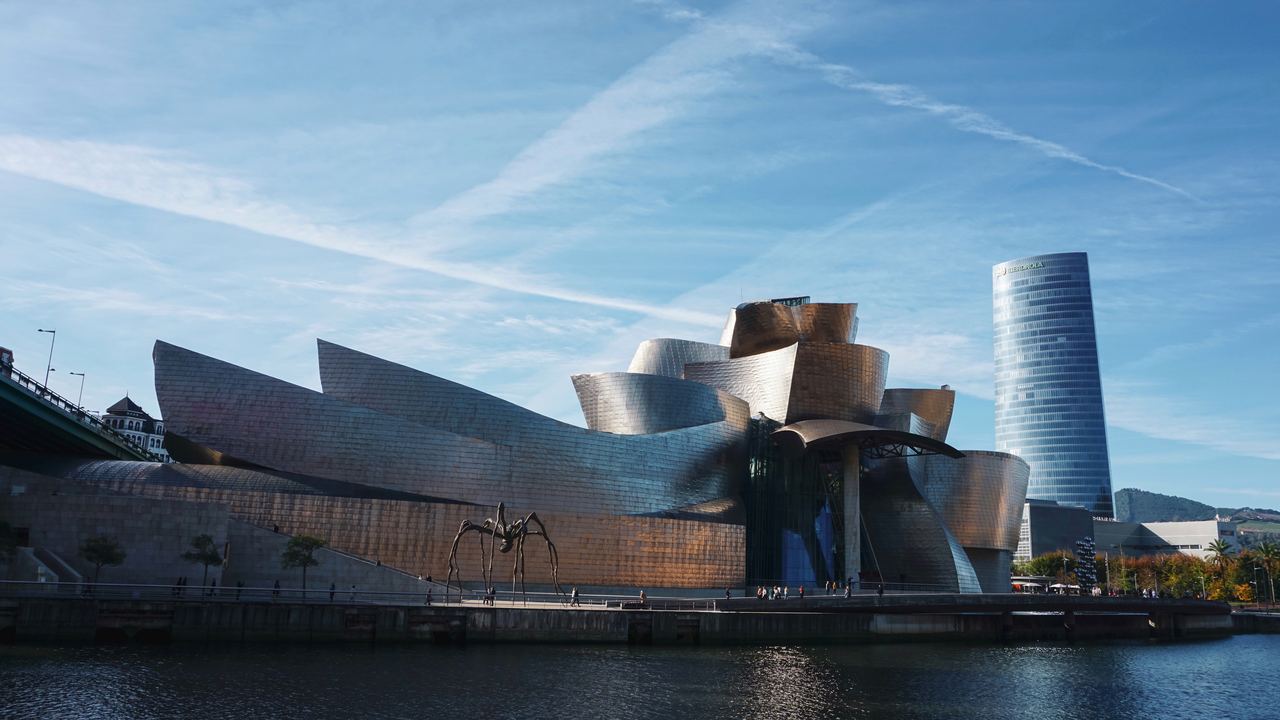
The short answer: Gehry's museum is the product of a contract, an architecture competition and a lot of software, and it did draw far more visitors than its backers predicted. The longer answer is that the number everyone repeats, a city saved by one building, does not survive a close look. The museum opened on 18 October 1997. Its visitor counts are real and published. Its economic-impact figures are estimates, almost all produced by the museum itself or by a single research group. We read the sources behind both, and this page sorts what is measured from what is claimed.
This site is independent and not affiliated with the museum or the Solomon R. Guggenheim Foundation. If you are planning a visit rather than reading about one, the practical details (hours, admission, tours) live on the Guggenheim Museum Bilbao page. Everything below was checked on 3 November 2026.

Who paid for the Guggenheim Bilbao, and what did the Foundation get?
The most common misconception is that the Guggenheim built a branch in Spain. It did not. According to a Harvard Graduate School of Design case study (Skylakakis and Pollalis, 2005), the Basque administrations paid 100 percent of construction and operating costs, split evenly between the Basque government and the provincial government of Bizkaia. The city of Bilbao supplied the land. No money came from the Spanish state.
What the Foundation received, according to the same case study, was $20 million, paid in two installments (February 1992 and February 1993), in exchange for its name, its expertise and access to its collection. In Spain the payment was described as a rental fee. The Basque side also set aside $50 million for an acquisitions fund, to be spent over four years starting in 1994, and budgeted roughly $100 million for the building and about $12 million a year to run it. These are the case study's figures for the 1991 to 1992 agreement; they are not audited accounts, and we have not seen the contract itself.
The Foundation agreed to operate and manage the museum, rotate parts of its collection and organize temporary exhibitions. The contract also states that the Foundation has no legal or financial obligation for the site, the design, the construction or ownership of the building. The Harvard authors compare the arrangement to a franchise. A management contract signed on 21 December 1994 added safeguards for the Basque side, among them a requirement for Basque consent before any other Guggenheim satellite in Europe and a minimum of three New York-caliber exhibitions a year.
Treat Bilbao as a Basque museum run with the Foundation's name and expertise, not as a New York branch. The building belongs to the Basque institutions, and so does the bill.
On ownership of the art, Thomas Krens told The Art Newspaper in 1998 that the Foundation chooses acquisitions but the title sits with a holding company created in Bilbao. Works bought for Bilbao carry the credit line "Guggenheim Bilbao Museoa." The arrangement was renewed in December 2014, when the Bilbao foundation's board approved (2 December) a 20-year extension to 2034, which the New York Foundation announced on 9 December. It includes an annual payment from the Bilbao foundation to the Foundation and an exhibition from the New York collection every two years.
How was Gehry chosen? The 1992 invited competition
You will see "1991" attached to the competition in many places. That is the year of the first proposal. The competition itself was in 1992. The same Harvard case study describes an invited competition with three firms: Arata Isozaki & Associates (Tokyo), Coop Himmelb(l)au (Vienna) and Frank O. Gehry & Associates (Los Angeles). Each received a $10,000 retainer and three weeks to produce a concept. Proposals were due by 20 July 1992, and a committee met in Frankfurt to decide. Krens later said the final choice came down to Gehry and Coop Himmelb(l)au. Isozaki had sent ten sketches of an elliptical four-story building.
Gehry had been involved earlier, in a different role. In May 1991 he accompanied Krens to Bilbao as a consultant on the choice of site, which is part of why the dates blur. The case study itself contains one inconsistent date for his first visit, and we resolved it the way the rest of its sequence does: 1991 for the proposal, 1992 for the competition.
How was the building made? CATIA, titanium and some very local decisions
The museum's own description of the construction says the building went up between October 1993 and October 1997. The skin is made of about 33,000 extremely thin titanium sheets, plus limestone and glass. Other sources give 35,000 or more than 40,000. We use the museum's "about 33,000" because it is the owner's figure and the only one with a stated origin. We do not give a thickness: figures from 0.3 mm to half a millimeter circulate, and none comes from a primary source we could open.
Gehry's studio used CATIA, software originally developed for the aerospace industry, to turn his physical models into a buildable structure. The museum says Gehry turned to it because of the mathematical complexity of his design, to translate the concept into a structure and to help the construction. The museum says Gehry chose titanium after ruling out other materials, and that he settled on it after seeing how a titanium sample pinned outside his office behaved.

What the Harvard case says about the details
Some of the building's most practical choices came from the local contractor, IDOM. The stone was set on a concrete block wall, a local tradition, rather than Gehry's steel structure. The titanium, which Gehry wanted to fix over plywood, went onto galvanized sheet metal, judged more durable in Bilbao's climate. It is a useful corrective to the genius-and-crumpled-paper story. Gehry himself has called the crumpled-paper origin a myth, and he worked from physical models of paper, cardboard and wood that were then digitized.
Three prices circulate for the building, and they measure different things. Ferrovial built it for $89 million, according to figures Wikipedia cites from the company and the Los Angeles Times (1997). The economist Beatriz Plaza gives $100.8 million for the building and its external works, and $228.3 million for the whole project before opening, a total that includes Gehry's fee, the Foundation's fee, the land and $44.5 million of art. The 1991 to 1992 plan had 9,800 million pesetas, about $93 million. Any sentence that starts "the museum cost" and does not say what it includes is not worth repeating.
Outside, the sculpture tells its own story. Jeff Koons's Puppy began as an 11-meter wooden version shown in 1992 at Bad Arolsen, in the Documenta IX program. The steel-framed version was acquired in 1997 and installed permanently in September 1997, in time for the opening. It is covered in seasonal flowering plants. The Fire Fountain is by Yves Klein, not Anish Kapoor, as a few guides have it.
Did Bilbao get the visitors it was promised? Expected against actual
The forecasters were wrong, and in the direction a museum director would like. A 1991 feasibility study expected about 400,000 visitors a year, half or more from outside Spain, and Juan Ignacio Vidarte, the museum's director general, has said it would take ten years to get there. Krens put the budget forecast at 485,000. In its first full calendar year, 1998, the museum counted 1,307,065.
A caution on "the first year." Beatriz Plaza's 2001 article describes 1.3 million as the first year, October 1997 to December 1998, but the museum's own table shows 259,234 for the last three months of 1997 and 1,307,065 for 1998 alone. The 1.3 million is the 1998 calendar year. The table below uses the museum's series.
| Year | Visitors | What to know |
|---|---|---|
| 1997 (Oct-Dec) | 259,234 | Partial year after the 18 October opening |
| 1998 | 1,307,065 | First full year; the first peak |
| 2002 | 851,628 | The low point of the series we found |
| 2006 | 1,008,774 | Back above one million |
| 2017 | 1,322,611 | Twentieth anniversary; includes free entries for residents of Bizkaia |
| 2019 | 1,170,669 | 69 percent from abroad |
| 2020 | 315,908 | Museum closed for almost three months, then restrictions; 61 percent Spanish visitors |
| 2021 | 530,967 | A year of partial recovery |
| 2023 | 1,324,221 | The highest figure in the series |
| 2025 | 1,305,003 | Official total; see the note on 1,260,894 |
On the 2025 figure: you may see 1,260,894 quoted. That was a running count reported in mid-December 2025 (Deia, 16 December). The official total, announced on 2 January 2026, is 1,305,003, of which 69 percent came from abroad. Two other numbers invite confusion. 451,353 in the 2022 Activity Report is the audience of a single exhibition, not the year's total. And the "25 percent above forecast" in the 2024 report compares the year with that year's budget, not with the 1991 prediction.
The pattern is worth noticing: a first-year spike, a slide to 851,628 in 2002, a slow climb, and then peaks in anniversary and blockbuster years. The 2022 exhibition Motion. Autos, Art, Architecture alone drew 751,243 visits between April and September. The museum has not been a steady 1.3 million a year since 1998. It has been a museum that clears a million most years and exceeds 1.3 million when it has a reason.
What do the economic-impact numbers actually say, and who measured them?
This is where careful readers should slow down. The impact figures quoted most often come from the museum, or from Beatriz Plaza, who has published most of the academic work on the subject. We found no independent audit. For 2025 the museum estimates a generated demand of 782.3 million euros, a contribution to Basque GDP of 676.7 million, 106.1 million in additional revenue for the Basque public finances and 14,319 jobs "maintained." It puts its self-financing rate at about 78 percent. For 2024 the Activity Report gives 784.6, 678.8 and 106.4 million euros and 14,366 jobs; a provisional figure announced in January 2025 was slightly lower, and the report supersedes it. Public contributions to the museum that year were 7.83 million euros.
You cannot line these numbers up across decades. The museum's 25-year cumulative estimate (2022) gave about 5,884 million euros of GDP and some 5,420 jobs a year on average. The 2025 estimate of 14,319 jobs is not a growth from 5,420; it is a different quantity, measured differently. The methods behind each year are not declared in the documents we read. We would treat every one of them as the museum's description of its own contribution.
| Estimate | Author | What it says | How to read it |
|---|---|---|---|
| Annual impact 2025 | Museum | 782.3 M euros demand; 676.7 M GDP; 106.1 M public revenue; 14,319 jobs | Self-published; method not stated |
| Annual impact 2024 | Museum (Activity Report) | 784.6 M demand; 678.8 M GDP; 106.4 M public revenue; 14,366 jobs | Supersedes the provisional January 2025 numbers |
| 25-year total (2022) | Museum, per press coverage | 5,884 M GDP; about 5,420 jobs a year | Cumulative; not comparable with annual figures |
| Return on investment | Plaza (2006), IJURR | Public cash flows repaid about seven years after opening | Counts public cash flows only; Plaza flags it as a bold claim needing scrutiny |
| Collection included | Plaza (2007) | Full cost, with art, repaid by 2010 or 2014 at the latest | A projection, not a result |
Who measured, who paid: every economic number for Bilbao comes from a party with a stake in the answer. Use them as the museum's account of itself, with the year attached.
Plaza's own caveats are instructive. Her discounted cash-flow method cannot see aesthetic or cultural value, she notes that researchers rarely see a museum's detailed accounts, and she calls Bilbao "close to a perfect lab" because no other museum is nearby, an assumption critics dispute. She also notes that consultants' visitor forecasts tend to run high, which is the opposite of what happened here.
What did the regeneration of Bilbao actually consist of?
Here the academic consensus is clearer than the headlines. J. Pedro Lorente's 2023 peer-reviewed article in Curator (open access) concludes that the "Bilbao effect" is a label coined by journalists without a clear meaning, that the city's revival came from many investments, and that the museum was the icing on the cake. Strictly speaking, he argues, the effect is the public attention the museum generated. Even the museum's director agrees. In a Yale interview, Vidarte said that if the museum had been the only project it would not have had the same impact, and that without the river cleanup, the metro and the port's relocation the museum would not have succeeded.
Before the museum, Bilbao was not a leisure destination. Plaza reports that in 1996 leisure travel accounted for only 8 percent of movements in the city, with business and trade fairs at 60 percent. Here are the dated public works that belong in the same story, taken from the dates in our fact pack:
| Project | Date | Note |
|---|---|---|
| Bilbao Ría 2000 (public regeneration company) | Founded November 1992 | Date from the company's own publication, via a search result |
| Metro, stations by Norman Foster | Service began 11 November 1995 | Two years before the museum opened |
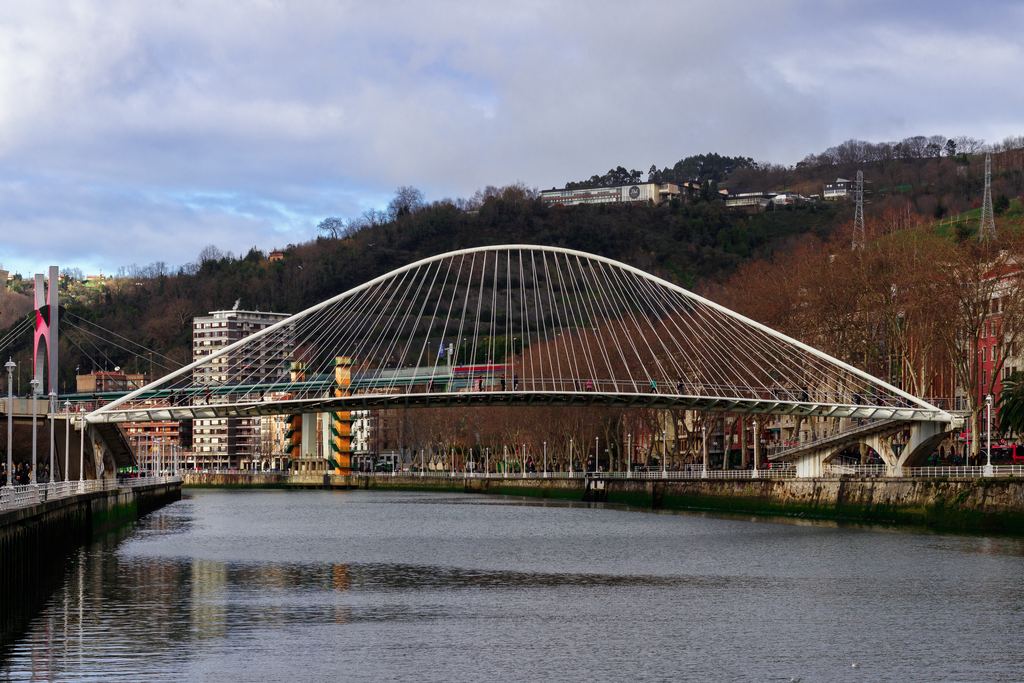
| Zubizuri footbridge, Santiago Calatrava | 1997 | Crosses the river near the museum |
| Euskalduna Conference Centre and Concert Hall | Opened 19 February 1999 | Built 1994 to 1999 |
| Tram | First six stops opened 18 December 2002 | Passes the museum |
| Azkuna Zentroa (former wine warehouse, Philippe Starck) | Works 2001 to 2010 | Warehouse built 1905 to 1909 |
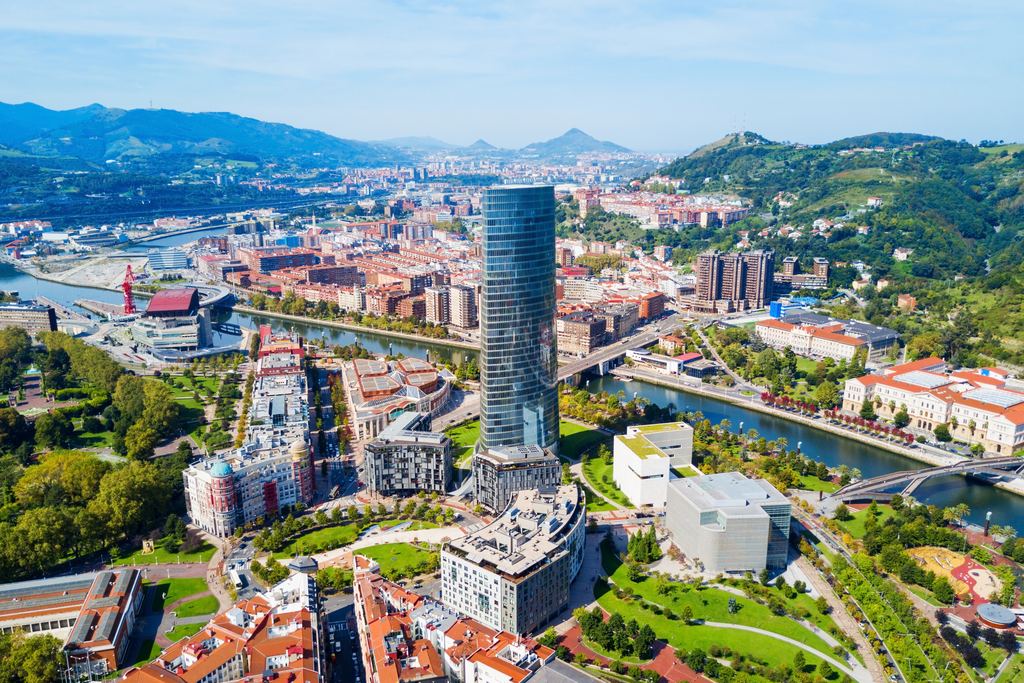
| Iberdrola Tower, César Pelli | Completed 2011 | 165 meters |
The plan behind these works was already moving. Harvard's account describes a renewal program of some 20 billion pesetas in public investment without state funds, and a public-private lobby, Bilbao Metropoli-30, with more than 120 members. The museum is one project in a program that also included drainage, air-quality work, riverside parks and the port.
What cannot be credited to the museum alone
No study we read isolates the share of Bilbao's change that belongs to the museum. Plaza's papers treat the museum as a case apart, while the same text lists the metro, the cleanup of water and air, the airport, housing and offices, parks and the concert hall. So, plainly: the riverfront, the transport network and the new skyline all had other causes working at the same time. We could not find a citable Bilbao-specific hotel series for 1996 to 2025 from the Basque statistics office, so we do not publish one.
The less cheerful findings are part of the record too. Lorente reports that only 9 percent of the museum's exhibitions through 2022 included Basque artists, though about 28 percent of the collection catalog is by them. He also notes early opposition from the artist Jorge Oteiza and others, and quotes the journalist Elena Vozmediano, who on the museum's tenth anniversary deplored press kits full of detailed visitor and revenue figures while everything about curatorial management stayed in the mist. A 2003 paper in Urban Studies by Vicario and Martínez Monje asks whether the museum produced "another 'Guggenheim effect'" in a potentially gentrifiable neighborhood of the city. We have read only that paper's title and listing, so we point to it without summarizing its findings.
Timeline: from first contact to a 25-year anniversary
Gehry's Bilbao in dated steps
Only dates with a stated source in our research are listed.
The origins
-
April 1991
First contact
Basque officials and the Foundation start talking; Gehry visits as a site consultant in May.
-
July 1992
Invited competition
Isozaki, Coop Himmelb(l)au and Gehry submit concepts by 20 July; a committee meets in Frankfurt.
-
October 1993
Construction begins
Work on the riverside site runs until October 1997.
-
11 November 1995
Metro opens
Foster's stations begin service two years before the museum.
The growth
-
18 October 1997
Museum opens
Puppy had been installed in September. The year closes with 259,234 visitors.
-
1998
First full year
1,307,065 visitors, against forecasts of 400,000 to 485,000.
-
19 February 1999
Euskalduna opens
The conference and concert hall joins the riverfront.
-
2002
Low point and tram
851,628 visitors; the tram's first stops open on 18 December.
Today
-
December 2014
Renewal approved
Twenty more years, to 2034.
-
2020
Pandemic year
315,908 visitors, with Spanish visitors in the majority at 61 percent.
-
2023
Highest count in the series
1,324,221 visitors.
-
2025
Latest official total
1,305,003 visitors, 69 percent from abroad.
What does Bilbao offer a visitor today beyond the museum?
If you are going because of the Bilbao effect, spend as much time on the city as on the building. The old town, the Casco Viejo, traces to a founding charter of 1300; which streets counted among the original "Seven Streets" is argued over, so be wary of guides that list them with certainty. The Artxanda funicular opened on 7 October 1915. The Vizcaya Bridge, built in 1893, a transporter bridge carrying passengers on a suspended gondola, has been a UNESCO World Heritage Site since 2006. Bilbao itself is not on the UNESCO list. Athletic Club, founded on 18 July 1898, plays in a 53,289-seat San Mamés; its policy is to field players born or trained in the Basque Country and nearby regions.
For food, the local habit is ir de potes: moving from bar to bar for one pintxo and one drink at each. Calle Diputación, Ledesma, Ercilla and the streets around Jardines de Albia are common areas, as is the old town. We do not recommend named bars because our sources for them were blogs. The Museo de Bellas Artes sits nearby and the two museums share a combined ticket; check its current price on the museum sites, because it changes.
If you want to see the building with someone who knows the district, our pages for city and architecture tours and for guided tours with admission explain the formats. Those tours are run by third parties, not by us or by the museum.
Questions people ask about the Bilbao effect
Who owns the Guggenheim Museum Bilbao?
The museum is governed by the Guggenheim Museum Bilbao Foundation, a body created in partnership between the Basque institutions and the Solomon R. Guggenheim Foundation. The Basque administrations paid for the building. The Foundation in New York is not its owner. See the contract section above.
How much did the Guggenheim Foundation receive for the Bilbao deal?
According to the Harvard Graduate School of Design case study, $20 million in two installments in 1992 and 1993. The Basque side also set up a $50 million acquisitions fund. We have not seen the contract.
Why did Gehry win the Bilbao commission?
He was one of three architects invited to compete in 1992, alongside Isozaki and Coop Himmelb(l)au. Krens said the final choice was between Gehry and Coop Himmelb(l)au. Reasons beyond that are interpretation, not record.
How many titanium sheets cover the museum?
The museum says about 33,000. Other sources give higher numbers; we use the museum's.
How many visitors was Bilbao supposed to get?
A 1991 feasibility study pointed to about 400,000 a year, and Krens later said the budget assumed 485,000. The museum counted 1,307,065 in 1998.
Did the museum pay for itself in six or seven years?
That is a claim from the museum's official 2004 report and from Beatriz Plaza's 2006 study of public cash flows. Plaza herself calls it a bold claim that needs scrutiny. Including the cost of the art, she projected recovery by 2010 or 2014.
Is the Bilbao effect real?
Attention and visitors followed the museum, and that is measurable. That a single building transformed the city is not what the research supports. Lorente (2023) calls the label a journalistic invention and describes the revival as the result of many investments.
Is the 'crumpled paper' story true?
Gehry has called it a myth, tied to a Simpsons cameo. His studio worked from physical models that were then digitized in CATIA.
Is Gehry still alive?
No. He died on 5 December 2025, aged 96.
Planning a visit to Bilbao?
Hours, admission and the formats of guided tours are on our Bilbao page. We checked them on 3 November 2026.
Tours that include Bilbao's museum
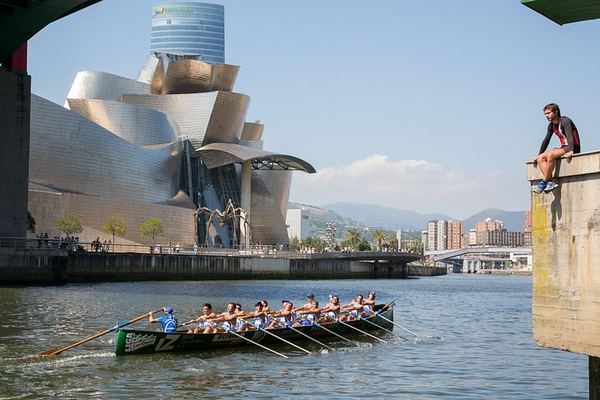
Half-Day Bilbao Trip from San Sebastián: Artxanda, Ribera Market, Guggenheim Audio Guide
A half-day trip from San Sebastián with a 9:00 am departure, the Artxanda Viewpoint, the Old Town and the Ribera Market, and an audio tour of the Guggenheim.
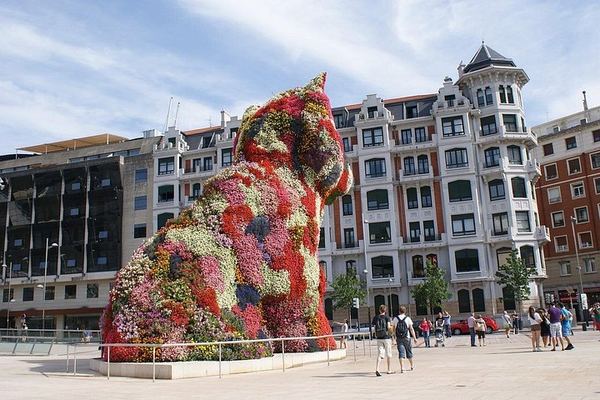
Private 2-Hour Guggenheim and Bilbao Walk, Customizable Between Museum and City
A private two-hour walk split between the museum and the city, and adjustable: more time inside the Guggenheim or on the streets of modern or old Bilbao.
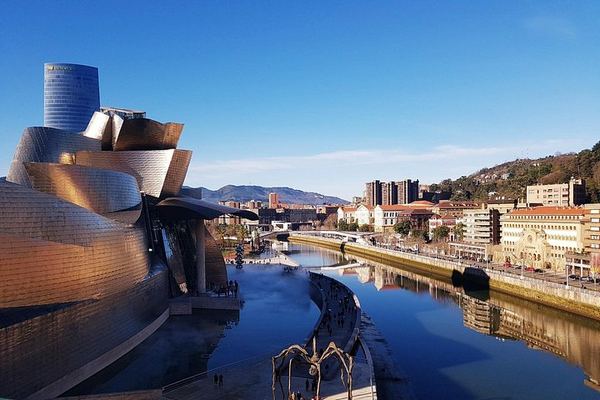
Guggenheim Bilbao Guided Tour in Spanish, 2 Hours, Art History Graduate Guide
A two-hour tour in Spanish led by a local guide with an art history degree, covering the exterior and the collections, with re-entry allowed the same day.
Ratings collected by Viator and Tripadvisor
Data verified on . Museum pages and press releases; Harvard GSD case (2005); Plaza (2007); Lorente (2023). Impact figures are the museum's estimates. Editorial Policy