
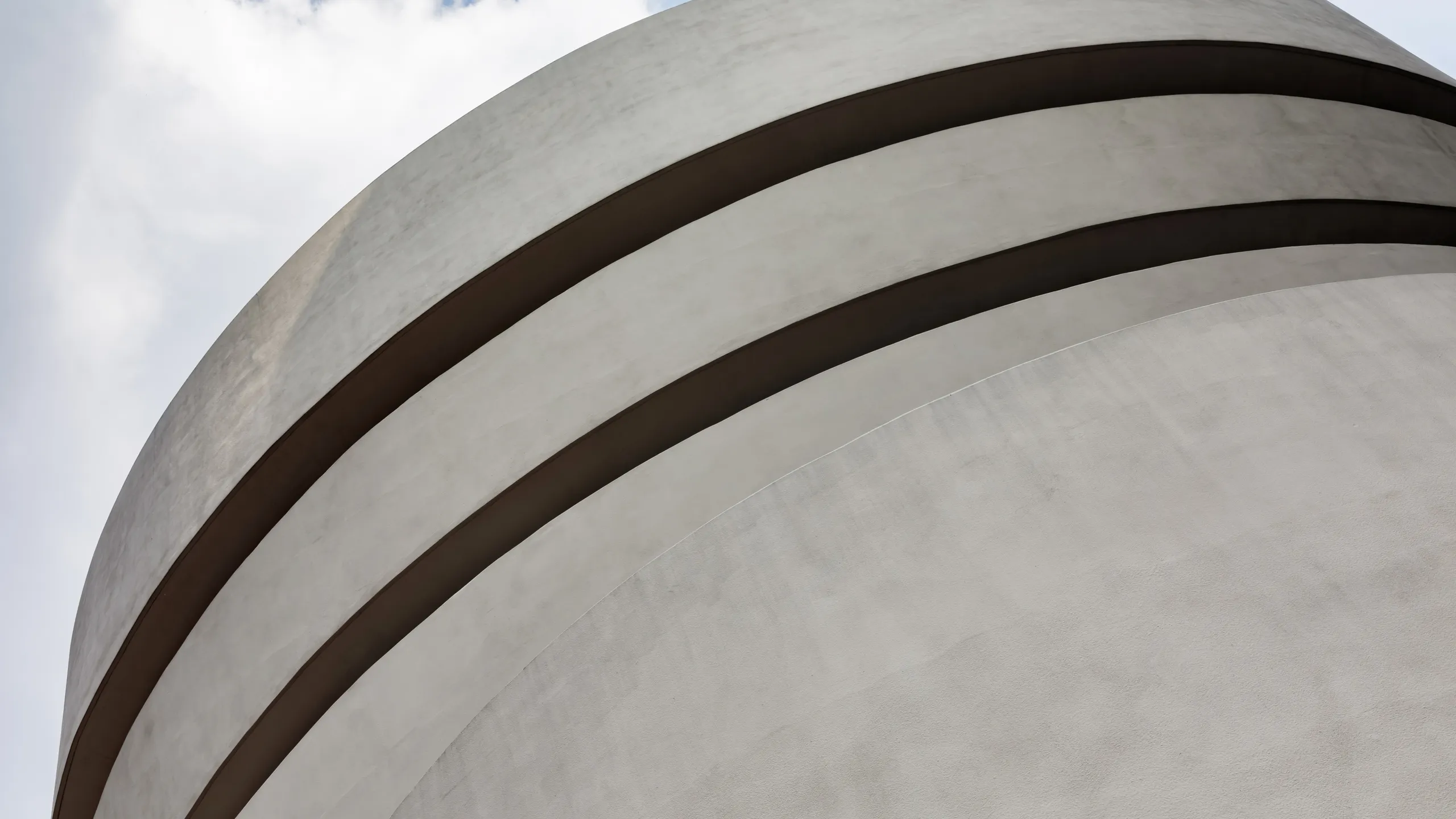
Most Guggenheim myths are small errors that got repeated until they sounded like facts: a percent where the museum says degrees, a year off by one, an artwork put in the wrong city. This page checks 23 of them against the museum's own pages first and says when we could not. The short version of the biggest ones: the New York ramp is three degrees, the Bilbao Fire Fountain is Yves Klein's, and Pollock's Mural is not in Venice. We are an independent site, not affiliated with the museums or the Foundation, and we checked on 3 November 2026.
A word on tone. Some of these errors come from competitor travel pages, and a few come from Wikipedia or from the museums' own contradictory pages. We name the source that settles it, not the page that got it wrong. Where we only have a secondary source, we say "reported" and flag it for review.
The myth table
| Myth | What is true | Source |
|---|---|---|
| The ramp has a 3 percent slope | Three degrees (about 5 percent), a quarter mile long | Museum Visitor Guide, Oct 2025 |
| The facade is marble | Sprayed Gunite concrete; marble was only a 1945 proposal | Museum Visitor Guide; NYC Landmarks report 1774 |
| Wright never saw his museum finished | He died 9 April 1959; it opened 21 October 1959. He did see the building well advanced | Museum architecture page; NYC Landmarks report 1774 |
| Wright hated New York | Mixed: in 1949 he wrote of 'several more desirable places', yet worked on the Fifth Avenue site | Museum teaching materials |
| Wright called it 'the archeological museum' | His word was 'Archeseum'. He also called it 'My Pantheon' | NYC Landmarks report 1774 |
| The Guggenheim is the only modern American building on UNESCO's list | It is one of eight Frank Lloyd Wright buildings inscribed in 2019 | UNESCO World Heritage list, ref. 1496 |
| The Wright building took 15 years | The museum says 16: 1943 to 1959 | Museum architecture page |
| The Fire Fountain at Bilbao is by Anish Kapoor | It is by Yves Klein (1961) | Bilbao museum collection page |
| Gehry crumpled a sheet of paper and the museum appeared | Gehry has called this a myth; he works with physical models that are then digitized | Report of Gehry's 2011 remarks; Bilbao museum |
| The skin is 40,000 titanium plates | The museum says approximately 33,000 extremely thin sheets; it publishes no thickness | Bilbao museum, building page |
| Puppy is a temporary installation | The 1992 wood version was temporary; the steel one was installed permanently in September 1997 | Bilbao museum, Puppy page |
| The museum alone rebuilt Bilbao | A peer-reviewed review calls it one investment among many; the museum's director agrees | Lorente 2023 (Curator); Yale Insights interview |
| Almost all visitors to Bilbao are foreign | 69 percent in 2025 were international, 10 percent Basque, 21 percent from the rest of Spain | Bilbao museum press release, Jan 2026 |
| Peggy kept 14 dogs | No primary source gives that number. Her ashes are in a corner of the garden | Venice museum, About Peggy page |
| Casati owned the palazzo and walked cheetahs in the garden | She rented it from the 1910s to 1924. The cheetahs-in-the-garden story has no primary source | Venice museum, Palazzo page |
| Peggy bought the palazzo in 1948 | July 1949 | Venice museum, Palazzo page |
| The palazzo is named after a lion in the garden | More likely after the stone lion heads on the facade | Venice museum, Palazzo page |
| Pollock's Mural is in Venice | It went to the University of Iowa (the museum's page dates the gift to 1948) | Venice museum, Mural page |
| You can see Dalí in Venice | The museum owns Dalí works, but none was on view on 3 Nov 2026 | Venice museum, artist pages |
| Strollers are not allowed at the New York museum | Strollers and soft front-facing carriers are allowed; rigid baby backpacks are not | Museum visiting FAQ, checked 3 Nov 2026 |
| McGuggenheim was coined by a famous critic | No coiner is known; the earliest use we found is 19 October 2001 | Christian Science Monitor, 2001 |
| The Guggenheim has five museums | Three are open; Abu Dhabi opens 11 Dec 2026. Berlin closed in early 2013 | Foundation history page; Abu Dhabi tourism authority |
| Abu Dhabi has 30 galleries | The same tourism page says 30 in one box and 28 in another | Abu Dhabi tourism authority page |

New York: the building
The ramp is three degrees, not three percent. The museum's Visitor Guide says the rotunda ramp is "a quarter mile long" and rises at "a three-degree incline". A three-degree slope is about 5 percent, so the 5 percent on Wikipedia and the museum's wording agree. The error is reading degrees as percent. A different number that circulates, 18 degrees, would be a steep street and is simply wrong. We skip the Wikipedia length of 1,416 feet because the museum itself says quarter mile.
The same guide says artworks are installed at an angle of one and a half degrees, "which appears straight" to the eye. That is probably the best thing to know before you go: the pictures are tilted on purpose.
It is concrete, not marble. The city's Landmarks report describes exterior layers of Gunite sprayed from inside against plywood forms, and the Visitor Guide says the walls are "only five inches thick" thanks to Gunite, a sprayed sand and cement mix. Marble came up in 1945 as an idea for the surface and did not survive. The color is not the original either: the museum's Mendelsohn article says it opened in a warm yellow-brown and was later repainted a light gray.
Wright did see the building rise. He died on 9 April 1959; it opened on 21 October 1959. "Never saw it finished" is half true.
Wright and New York. He did not love the city. In 1949 he wrote that he could think of several more desirable places in the world, but they would have to try New York, and he still took a Fifth Avenue site beside Central Park. That is not the same as hating it. He also named the building himself, and not as a museum: Archeseum, in his words "a building in which to see the highest" (as quoted in the New York City Landmarks report), and he called it "My Pantheon". The museum describes the shape as an "optimistic ziggurat".
Years. The museum says sixteen, 1943 to 1959, with construction starting in 1956. Another number that circulates, fifteen, does not match the museum's own count.
UNESCO. The museum is on the World Heritage list, but as one of eight Frank Lloyd Wright buildings inscribed in 2019 under "The 20th-Century Architecture of Frank Lloyd Wright". One travel blog calls it the only modern American entry, which is not what the list says.
Bilbao: the building and the effect
Fire Fountain. The work in the water outside is Fire Fountain by Yves Klein, dated 1961. The museum's page says it realizes a project Klein never finished before his death in 1962. People mix it up with Anish Kapoor's Tall Tree & The Eye (2009), which is nearby.
Titanium. The museum says "approximately 33,000 extremely thin" sheets, so use 33,000 with "about". Other sites say 35,000 or more than 40,000. The museum does not publish a thickness, so any number to the tenth of a millimeter has to be treated with suspicion. It also says Gehry chose titanium after watching a sample fixed outside his studio, and that the design was developed with CATIA software.
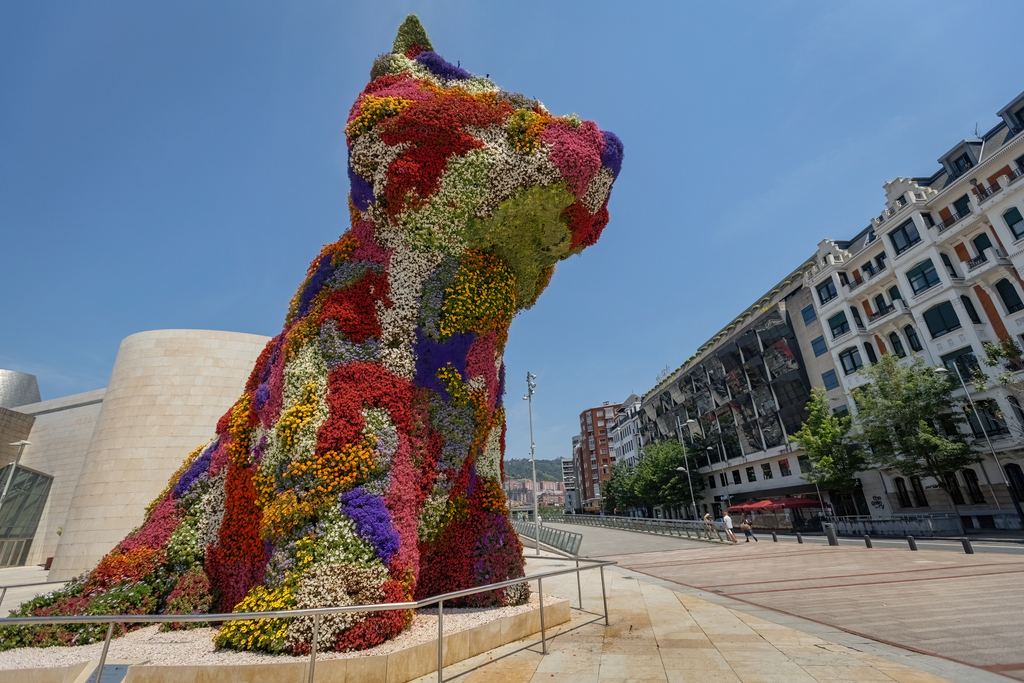
Puppy is permanent now. A wooden 11-meter version appeared at Documenta IX in 1992 and was taken down. The steel version was acquired in 1997 and installed in front of the museum in September 1997. The museum's page calls it permanent. The flowers are reported to be changed twice a year, according to Wikipedia and press items; we mark that as secondary.
Crumpled paper. A lovely image, and per a 2011 report Gehry himself calls it a myth. He works with models of paper, cardboard and wood and then scans them. We would not repeat the crumpled-paper story as fact.
James Bond. It is true that the pre-title sequence of The World Is Not Enough (1999) is set in Bilbao with the museum in the background. We found this in film-trade coverage, not a museum page, and we deliberately skip filming dates because the sources disagree.
The Bilbao effect. The claim that one building rescued a city makes a good headline. The museum's own director said in an interview that if the city had not cleaned its river, built its metro and moved its port, the museum would not have succeeded. A 2023 peer-reviewed article in Curator says the label was coined by journalists and that the urban revival came from many investments. The museum's yearly economic estimates are its own: the 2025 figures were 782.3 million euros of generated demand and 14,319 jobs, and the numbers are not independent audits.
Visitors. The 2025 total is 1,305,003. A lower figure, 1,260,894, was a mid-December running count. In 2025, 69 percent of visitors were international, 10 percent from the Basque Country and 21 percent from the rest of Spain. So "nine in ten come from elsewhere" is true only if you count Spaniards as elsewhere.
Venice: the palazzo and Peggy
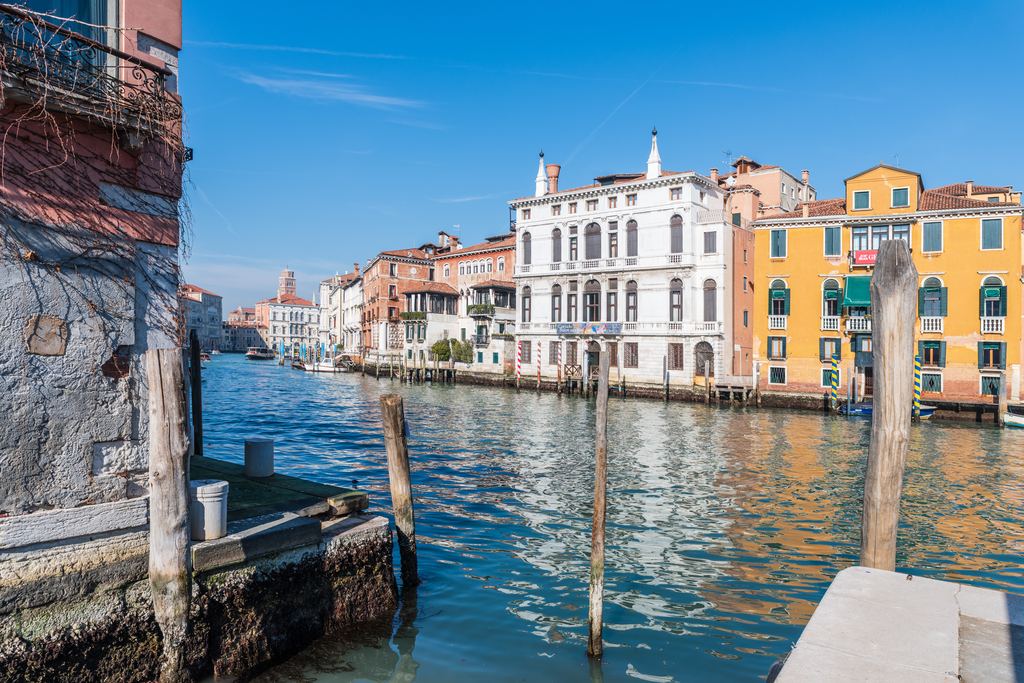
A palazzo that was never finished
The museum says the Venier family commissioned the palazzo in 1749 and only the first of five planned floors was built. That is a better story than the invented ones, and it is on the museum's own page.
1949, not 1948. Peggy Guggenheim bought the palazzo and garden in July 1949. In 1948 she exhibited at the Venice Biennale, which is where the confusion starts. She donated the palazzo to the Foundation in 1970 and the collection in 1976, according to the museum's biography page.
Casati and the cheetahs. Marchesa Luisa Casati rented the palazzo from the 1910s until 1924, per the museum, so "she owned it" is wrong. Cheetahs on a leash are part of her legend, but nothing primary places them in this garden. We leave them out.
The lion. The museum's palazzo page says a lion was reportedly kept in the garden, but the name is more likely from the Istrian stone lion heads on the facade.
The dogs. Fourteen is a number from blogs. The museum's biography page says her ashes are placed in a corner of the garden and does not give a count of dogs.
Pollock and Dalí. Peggy commissioned Mural from Pollock in July 1943 and he finished it in early November 1943. She donated it to the University of Iowa in 1948. Venice does have other Pollocks, among them Alchemy. Dalí's Birth of Liquid Desires belongs to the collection, but the museum's pages tagged it "not on view" on 3 November 2026. See our movements primer for the rest.
"A picture a day". The motto is hers, from her autobiography Out of This Century: "Buy a picture a day". It is a motto, not an inventory.
The Foundation and Abu Dhabi
McGuggenheim. The nickname for the franchise-style expansion has no known inventor. The earliest use we found is a Christian Science Monitor piece dated 19 October 2001, and no source credits a specific critic.
How many museums. The Foundation's history page names New York, the Peggy Guggenheim Collection in Venice, Bilbao and "the future Guggenheim Abu Dhabi". Three are open. Deutsche Guggenheim in Berlin ended in early 2013, and Helsinki was rejected twice: 8 to 7 by a city board in 2012, then 53 to 32 by the council in 2016. Bilbao is run by its own Basque foundation in partnership with the Foundation, so "the Guggenheim owns Bilbao" is not how the museum describes it. For the closed branches see The Guggenheim branches that closed.
Abu Dhabi. It opens on Friday 11 December 2026, per the Abu Dhabi tourism authority, which means it is not open yet. One local magazine called that date a Monday. The same tourism page gives both 30 and 28 galleries, so quote it as "28 or 30 galleries". One detail that holds up: the design by Frank Gehry has ten sculptural cones and rises to 88 meters, per the same authority. Gehry died on 5 December 2025, at 96.
One checked curiosity per museum
If you only remember four things
New York: pictures are hung tilted
Artworks sit at an angle of one and a half degrees, which the museum says looks straight to the eye.
Bilbao: Puppy began in wood
An 11-meter wooden version stood at Documenta IX in 1992; the steel one arrived in 1997.
Venice: only one floor was built
The palazzo was planned with five floors in 1749 and only the first was built.
Abu Dhabi: the date is a Friday
The opening date, 11 December 2026, falls on a Friday, not a Monday.
Spot a myth yourself
Three habits help: ask whether a number has a unit (degrees or percent), check whether a date matches the museum's own biography page, and treat any story about a famous person's pets as folklore until a primary source turns up.
Guggenheim myths: quick answers
How steep is the Guggenheim ramp in New York?
Three degrees, about 5 percent. The museum describes it as a quarter mile long.
Is the Guggenheim New York made of marble?
No. It is sprayed concrete (Gunite) with walls about five inches thick.
Did Frank Lloyd Wright see the museum open?
No. He died in April 1959 and the museum opened in October 1959, though he saw the building well advanced.
Who made the Fire Fountain at Bilbao?
Yves Klein, in 1961, not Anish Kapoor.
Is Pollock's Mural in Venice?
No. It was given to the University of Iowa in 1948.
When did Peggy buy the palazzo?
July 1949, according to the Venice museum.
Did one museum transform Bilbao?
It helped, but a peer-reviewed study and the museum's own director describe a wider program of investments.
Is the Guggenheim Abu Dhabi open?
Not on 3 November 2026. The announced opening is 11 December 2026.
Visit the Bilbao myth in person
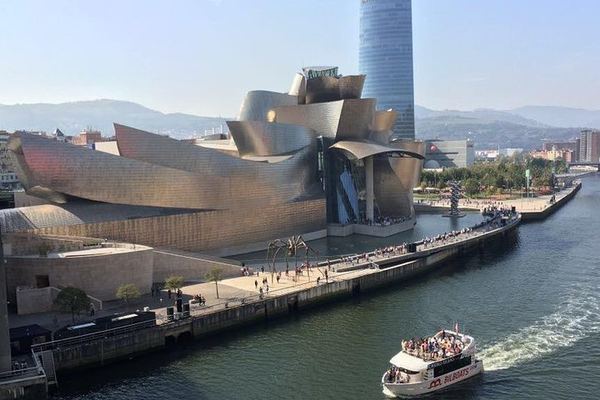
2-Hour Bilbao E-Bike Tour: Old Town Views to Guggenheim and Zubizuri
A 2-hour guided e-bike ride for visitors short on time, from the estuary and La Ribera Market to San Mames, the Euskalduna Bridge and the Guggenheim area.
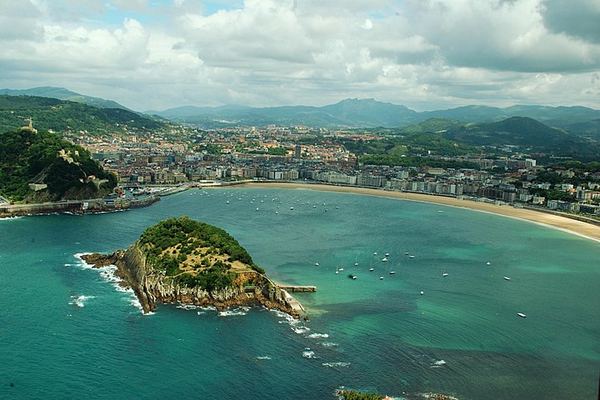
3-Day Private Basque Country Tour: San Sebastián, Bilbao Guggenheim, Biarritz, Hondarribia
Three days with licensed local guides from Basque Guides: San Sebastián's Old Town, Bilbao and the Guggenheim, then Biarritz, Saint-Jean-de-Luz and Hondarribia.
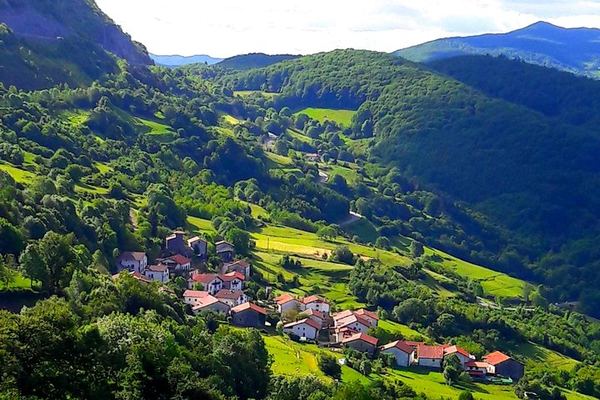
5-Day Private Basque Country Tours: Coast, Biarritz, Bilbao and Rioja Wineries
Five days of private guided tours in the Basque Country, from the Gipuzkoa coast and Biarritz to Bilbao's Guggenheim and two Rioja wineries with lunch.
Ratings collected by Viator and Tripadvisor
Data verified on . Museum pages first; secondary sources are marked 'reported'. See Editorial Policy. Editorial Policy