This glossary explains 80 words you will meet planning or taking a Guggenheim visit, from art labels to ticket jargon. It is grouped into four sections: art terms, architecture terms, visiting terms, and people and places. Where a word is used loosely by sellers, we say what it means in practice.
If a listing uses "skip-the-line," "VIP" or "exclusive," read what is actually included, not the badge.
This site is independent and not affiliated with any Guggenheim museum or the Foundation. Definitions come from Tate, the museums' own pages and standard references, checked on 3 November 2026. See the museums hub for more.
Art terms
Non-objective art
Non-objective art is abstract art with no recognizable subject at all. Tate describes it as a pure, often geometric form of abstraction. The Guggenheim began under this name in 1939, as the Museum of Non-Objective Painting, so the word explains the museum's whole origin. Kandinsky is the usual example.
Abstract art
Abstract art is the wider family. Tate says it does not try to depict visual reality accurately, and builds its effect from shapes, colors and marks. Non-objective art is the strictest branch. Plenty of abstract paintings still start from a landscape or a face and simplify it.
Cubism
Cubism was developed by Picasso and Braque around 1907 and 1908. It shows several viewpoints of one subject in a single picture, so the subject looks broken into facets. Tate separates an analytic phase (about 1908 to 1912) from a synthetic one (about 1912 to 1914). Later Picasso works are often called post-Cubist, not Cubist.
Surrealism
Surrealism tried to balance logic with dreams and the unconscious, finding wonder in the strange. André Breton published its first manifesto in 1924. Venice is the Guggenheim's strongest Surrealist address, with Magritte and Ernst. De Chirico's earlier metaphysical paintings are a related but separate story. The movements primer sorts them out.
Abstract Expressionism
Abstract Expressionism is the non-figurative American painting of the 1940s and 1950s, built on scale, gesture and immediacy. It has nothing to do with German Expressionism despite the similar name. Pollock and Rothko are the names visitors look for; check the individual museum's own listings, since the Pollock works in the Foundation sit in more than one city.
Minimalism
Minimalism is an extreme form of abstraction that emerged in the United States in the 1960s, using plain geometric forms and rejecting any outside subject. Material and form are the point. In everyday speech "minimal" just means plain, which is why the art term confuses people. Judd, Flavin and Andre are the core names.
Pop Art
Pop Art took its images from advertising, comics, media and consumer goods, peaking in the 1960s in the United States and Britain. It challenged what counted as art. Warhol and Lichtenstein are the standard names. Koons is often called neo-pop, but that label is commentary, not a strict category.
Impressionism
Impressionism is the 19th-century French habit of painting outdoors, quickly, with landscapes and daily life as subjects. The painters held their first group show in 1874. In New York, the Thannhauser Collection is where you meet its circle, such as Degas and Manet, rather than a gallery of pure Impressionists.
Post-Impressionism
Post-Impressionism covers painters who, from about 1886, pushed beyond Impressionism in different directions: Cézanne, Seurat, Gauguin, Van Gogh. It is not a single group with a program, just a convenient shelf label. Van Gogh and Cézanne both appear in the Foundation's collection.
Conceptual art
Conceptual art puts the idea before the object. It ran from the mid-1960s to the mid-1970s, and Sol LeWitt used the term in a 1967 article. Duchamp is the forerunner. Lawrence Weiner's works are often just statements of text, so expect words on a wall or instructions rather than a finished object.
Land art
Land art means work made in the landscape itself, by reshaping terrain or building with stone and branches. Museums usually show only documentation: photographs, maps, mirrors in a gallery. Do not assume a museum with a land artist in its collection can take you to the site.
Futurism
Futurism was an Italian movement of the early 20th century obsessed with speed, energy and modern life. Severini's Sea=Dancer (1914) is the Venice example that visitors tend to miss. Check the museum's current display before you plan around any single painting.
Collage
Collage is both a technique and the resulting work: paper, photographs, fabric or other flat material pasted onto a surface. The word comes from French, and Tate links it to papiers collés, the pasted-paper pieces of Picasso and Braque. Think flat layers, not objects in three dimensions.
Assemblage
Assemblage joins found or bought objects into a three-dimensional work. That is the difference from collage, which stays flat. If you are looking at a sculpture made of a chair, a tin and a wheel, the right word is assemblage, even if the label does not say so.
Readymade
A readymade is an everyday manufactured object chosen and presented as art. Marcel Duchamp coined the term. The artist's choice, not craftsmanship, is the claim. If a museum label says "readymade," the object really was bought, not carved.
Kinetic art
Kinetic art depends on movement for its effect, whether driven by motors, wind or the viewer walking past. In a museum it can mean a piece is only fully visible when switched on, so a still photograph of it is a poor guide to what you will see.
Mobile
A mobile is a sculpture of light elements hung so that air currents move them, the form linked with Alexander Calder. In American English it also means a cell phone, which is why a casual search can go astray. We have not confirmed a Calder mobile on display at any Guggenheim.
Installation
Installation art fills a room or space that the visitor walks into, often made for one site or for a limited time. The word has a second meaning: the installation of an exhibition is the physical hanging of the show. Kusama's Infinity Mirrored Room in Bilbao's collection is the kind of work people mean, when it is on view (it needs its own reservation, so check the museum).
Site-specific
A site-specific work is made for a particular place and loses much of its meaning if moved. Serra's steel pieces in Bilbao are a good example. It does not describe every work that simply happens to be on view somewhere, though tour sellers sometimes use it loosely.
Retrospective
A retrospective surveys an artist's whole career. We use the word as it is widely used in museums; the Guggenheim's "Collection in Focus" shows are different, since they are selections from its own holdings. A retrospective should tell you how many decades it covers before you buy a ticket.
Provenance
Provenance is the documented chain of ownership, custody or location of an object. A solid provenance helps confirm authenticity and shows a work was not stolen or looted. Wikipedia sums it up that way. Labels sometimes list previous owners; those lines are the provenance, and they can be fascinating.
Catalogue raisonné
A catalogue raisonné is a scholarly reference that documents an artist's known works, with titles, dates, dimensions and media, used to identify and authenticate them. You will never need one in a gallery, but it explains why a label can say "cat. rais. 1234."
Architecture terms
Rotunda
The rotunda is the large, open, spiraling central hall of the New York building, under a glass dome. It is the space people photograph from the ground floor and from the top. Do not confuse it with the "small rotunda," the smaller cylinder next door that Wright called the Monitor. See Wright's spiral.
Oculus
An oculus is a round opening at the top of a dome, from the Latin for eye. Britannica uses the Pantheon in Rome as the classic example, and Wright called his museum "My Pantheon." The New York museum itself describes a domed skylight; "oculus" is the architectural name visitors use for it.
Ramp
The ramp in New York is the spiral walkway around the rotunda. The museum's Visitor Guide gives it as a quarter mile long at a gentle slope of three degrees, which is roughly a 5 percent grade. Confusing degrees with percent is where the odd "3 percent" figure online came from.
Gunite
Gunite is sprayed concrete, a mix of sand and cement shot onto a frame. It let Wright build the exterior walls only about five inches thick. The New York facade is therefore not stone: a thin sprayed shell, which is part of why the building feels smooth and unjointed.
Ziggurat
A ziggurat is a stepped, pyramid-like tower. Wright's museum is an inverted one, widening toward the top, and the museum itself calls it an "optimistic ziggurat." The shape explains why the building looks like it is balanced on its narrow end, and why the top floor of the rotunda is the widest.
Monitor
The Monitor is Wright's name for the smaller cylindrical volume beside the rotunda. The Thannhauser Collection is shown on its upper floors today. In architecture the word can also mean a raised roof lantern, but at the Guggenheim it is a proper name.
Archeseum
Archeseum is the name Wright wanted for the building, glossed as a place in which to see the highest. It is not "archeological museum." He also called it "My Pantheon." Most visitors have never heard the word, which is a small shame, because it states his ambition in one coinage.
Organic architecture
Organic architecture is Wright's idea that a building should grow from its site and purpose as a unified whole, not be a box with decoration added. It is a philosophy, not a style, so it describes buildings as different as Fallingwater and the museum's spiral.
Usonian
Usonian refers to Wright's affordable single-family houses: open plans, flat roofs, deep overhangs, no basement or garage. The Guggenheim is not Usonian. If a website describes the museum that way, it has mixed up Wright's low-cost houses with a major civic building.
Landmark designation
Landmark designation is legal protection for a significant building. The New York museum was designated a city landmark in 1990 and a National Historic Landmark in 2008, according to secondary sources. Tour sellers use "landmark" loosely for anything old, so look for the formal designation.
UNESCO World Heritage
UNESCO World Heritage status is a global listing. The New York museum is one of eight Wright buildings in the 2019 serial inscription, "The 20th-Century Architecture of Frank Lloyd Wright." Bilbao is not a World Heritage site; the Vizcaya Bridge nearby is, since 2006.
Deconstructivism
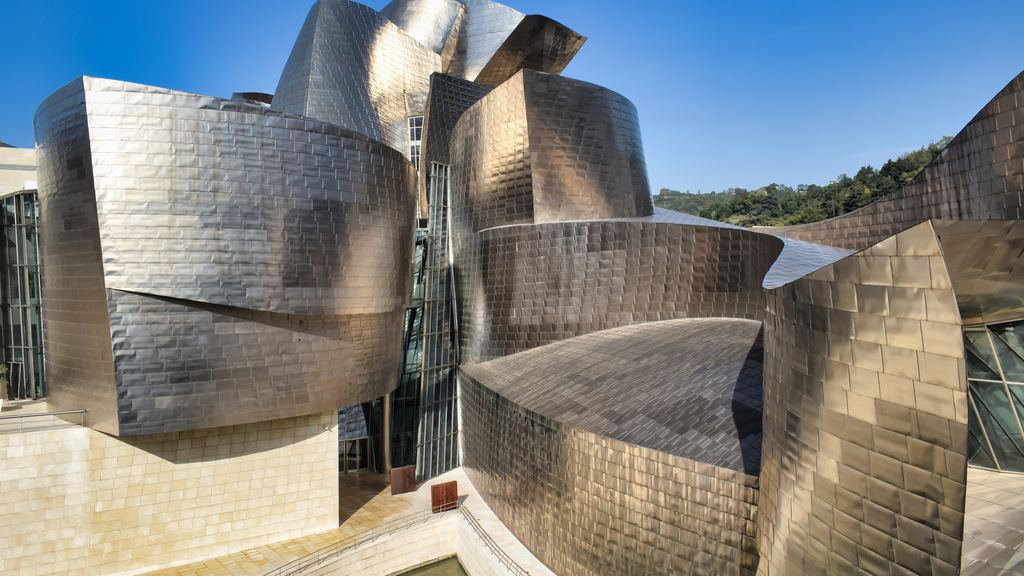
Deconstructivism is a postmodern architectural label for fractured, asymmetrical forms, popularized by a 1988 MoMA exhibition that included Gehry among seven architects. Gehry himself has rejected the label, according to Wikipedia. Treat it as a critic's tag, not a self-description. See Gehry's Bilbao.
Titanium cladding
The titanium cladding of the Bilbao museum is made of about 33,000 very thin sheets, according to the museum's own construction page. The finish is rough and shifts color with light and weather. The museum does not publish a thickness, so ignore the confident millimeter figures that float around.
CATIA
CATIA is software originally built for aerospace design. Gehry's team used it to turn sculptural models into buildable structure for Bilbao, according to the museum. It is the quiet reason the curves could be built at all: the software could give a position to every steel member.
Atrium
An atrium is a large, open central space that organizes a building. In Bilbao, the museum's three levels are organized around it and linked by curved walkways, titanium and glass elevators and staircases. If you get lost, head back to the atrium; every floor opens onto it.
Cantilever
A cantilever is a structure supported at one end and projecting into space, like a balcony without a column beneath. Architects use it to create the sense of floating. It is a general engineering term; we do not claim any particular Guggenheim balcony is a cantilever unless the museum says so.
Facade
Facade (also "façade") means the face of a building, usually the front. At the Guggenheim it matters: New York's is sprayed concrete, Bilbao's is titanium, limestone and glass, and the Venice palazzo's low front is the part of an unfinished building that was actually built.
La Salve bridge
The La Salve bridge crosses one end of the Bilbao museum site. Gallery 104 runs beneath it and ends in a tower that wraps around the bridge. Daniel Buren's Red Arches have stood on it since 2007. It is the bridge you cross without noticing you are inside the architecture.
Gallery 104
Gallery 104 is the long hall in Bilbao that houses Richard Serra's The Matter of Time, made of weathering steel between 1994 and 2005 and shown permanently. It stretches under the La Salve bridge without interior columns. The curved steel walls are the reason to go in slowly.
Nasher Sculpture Garden
The Nasher Sculpture Garden is the garden of the Peggy Guggenheim Collection in Venice, a place for sculpture beside the Grand Canal. The museum's pages do not explain the origin of the name. Note that food and drink are not allowed there, and neither are bags in the museum.
Visiting terms
Timed entry
Timed entry means you buy a ticket for a set arrival window. It manages crowds and is not a guarantee of an empty gallery. Rules change by museum and season, so confirm on the museum's own page. Our tickets page has dated details.
Pay what you wish
Pay what you wish (PWYW) lets visitors choose their admission within a set window. In New York it is a short fixed window on set days. Windows, like prices, change, so check the current terms and whether you need to book.
Reduced fare
A reduced fare is a lower-priced ticket for defined groups such as students, seniors or people with disabilities. You will usually need ID. Each museum sets its own categories and ages, so a discount that works in New York may not exist in Bilbao or Venice.
Concession
Concession is British for a reduced ticket. In American English it usually means a food stand. On a booking page it almost always means the discounted fare, but read the fine print on who qualifies. The table below compares the four entry words people confuse.
Coat check
The coat check is the museum cloakroom. New York offers it free with admission, and backpacks must be checked or carried in your hand or on your front; anything over 22 by 14 by 9 inches is not allowed in at all. Bilbao has a bag-size limit and Venice does not admit bags or backpacks at all, with lockers at the ticket desk. It is a courtesy and a rule at once.
Last admission
Last admission is the final time you can enter before closing. It is earlier than the closing time itself, so a ticket for the last slot gives you a short visit. We do not list the times here because they change; check the museum's page.
Skip-the-line
Skip-the-line is the most abused phrase in museum ticketing. In practice it means you avoid the ticket-desk queue because you bought ahead. It does not remove security screening or any entry queue, and we found no museum page promising otherwise. Treat it as "ticket in hand," not "no waiting." See how to choose a tour.
Fast track
Fast track is a seller's label for priority entry. There is no official definition we could find, so what you actually get depends on the operator and the museum. Ask what step it saves before paying extra, and assume security still applies.
Small group
Small group means a smaller-than-usual tour party, but the limit differs by operator, and none is set by the museums. Look for a number in the listing, such as a maximum of 12, instead of the adjective. Without a figure, the phrase tells you nothing.
Private tour
A private tour is a guide for your party only. It does not imply special access, early entry or closed galleries. You are paying for pace and attention, which can be worth it, but the museum's ordinary rules and your ticket still apply.
VIP
VIP is a commercial label from resellers. We found no documented official VIP access at the Guggenheim museums. If a listing uses the word, read the included items, such as a guide or priority entry, and judge those, not the badge.
Exclusive
Exclusive on a tour listing normally means the operator offers it. It rarely means closed doors or hidden rooms. The only exclusivity worth paying for is one you can name: a private guide, a small party, a time slot with a stated benefit.
Hop-on hop-off
Hop-on hop-off describes a bus or boat loop where you board and leave at any stop during the day. It suits city sightseeing, not a museum visit. A ticket may include the museum or not; check, because the transport and the entry are often sold separately.
Audio guide
An audio guide is recorded commentary played on a device or your phone. It is not a guided tour, because nobody answers questions. Bilbao's ticket includes one, according to the museum, and Venice sells one for a fee. New York's equivalent is the free Digital Guide.
Digital Guide
The Digital Guide is New York's free app-based guide, built on Bloomberg Connects. Download it before you arrive, and bring earphones. It supplements wall labels and is not a replacement for a live guide.
Docent
A docent is an American term for a trained volunteer or educator who guides visitors. We have not confirmed that the Guggenheim itself uses the word, and tour sellers use it for paid guides, so ask whether a listing means a volunteer or a licensed professional.
Collection in Focus
Collection in Focus is the name of a series of New York shows drawn from the Guggenheim's own holdings, often built around one artist or one theme. It differs from a retrospective, which surveys a whole career, and from a loan exhibition. Check the dates, because these displays rotate.
Biennale
A Biennale is an international art exhibition held every two years; the famous one is in Venice. It is not part of the Guggenheim, though the Foundation has owned the American pavilion there since 1986. If your trip overlaps, the Biennale adds crowds and extra ticket decisions to a Venice visit.
Vaporetto
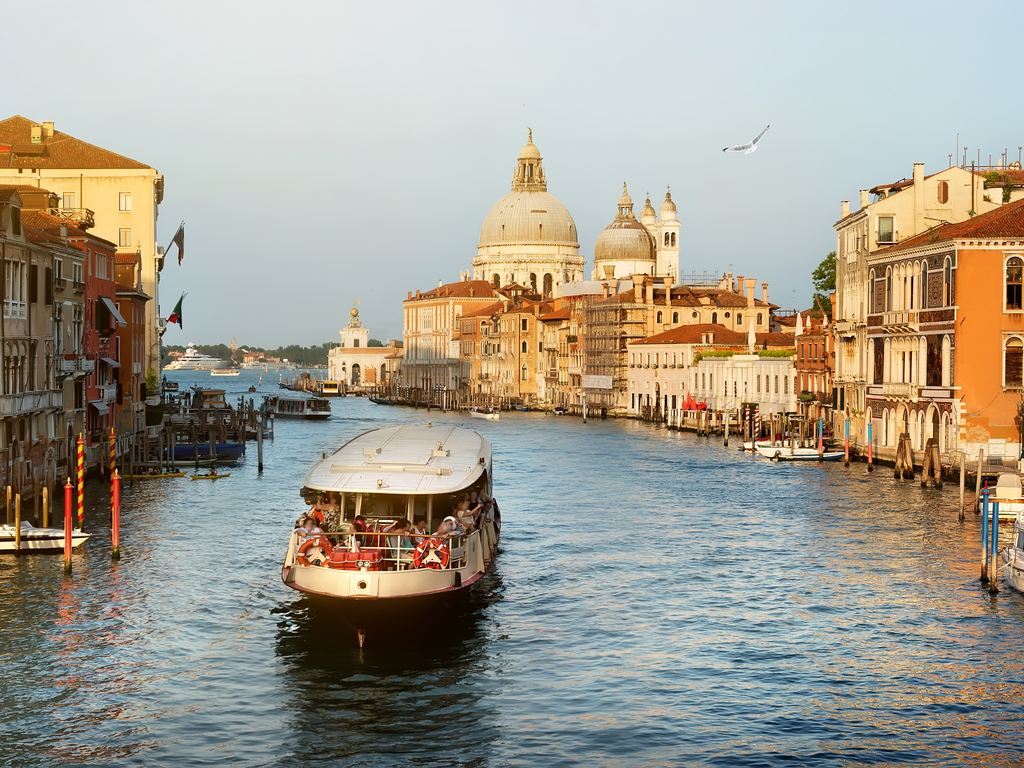
The vaporetto is Venice's public water bus. The Peggy Guggenheim Collection says to take line 2 or line 1 to Accademia, or line 1 to Salute. Fares and passes change, so date any price you read. A gondola is a ride, not transport.
Acqua alta
Acqua alta means "high water": exceptional tides that flood parts of Venice, mostly from autumn into spring. The record is 194 centimeters, on November 4, 1966. The museum does not publish a policy on closures for it, so check the day's forecast and the museum's page.
MOSE
MOSE is the system of mobile barriers across the lagoon inlets to protect Venice from flooding. It has 78 gates at the Lido, Malamocco and Chioggia inlets. Older papers sometimes cite 79, so numbers vary. Check the operator for how often it has been raised.
Pintxo
A pintxo is a Basque bar snack, usually held together with a toothpick, paid for separately from the drink. In Bilbao people move from bar to bar. It is not the same thing as a tapa, though visitors use the words interchangeably, which locals tolerate.
| Word | Where it is used | What it means | What to check |
|---|---|---|---|
| Concession | UK English | Reduced-price ticket | Who qualifies and what ID |
| Reduced | US and museum sites | Lower fare for defined groups | Age limits, student status |
| Pay what you wish | New York | You choose within a set window | Day, hours, advance booking |
| Free | All three museums | No charge for named groups | Whether a booking is still needed |
People and places
Solomon R. Guggenheim
Solomon R. Guggenheim was an industrialist and collector whose foundation, set up in 1937, started the museum system. He died in 1949, ten years before the New York building opened. He is the uncle of Peggy, who built a separate collection of her own.
Hilla Rebay
Hilla Rebay was a German painter who advised Solomon, directed the first museum, and chose Wright as architect. Sources differ on when her directorship ended, so we give no year. Her taste for non-objective art shaped the collection's first decades.
Peggy Guggenheim
Peggy Guggenheim was a collector who opened her Venice home to the public in 1951 and gave her collection to the Foundation. She lived in the palazzo after buying it in July 1949. Read her story on our Venice page.
Frank Lloyd Wright
Frank Lloyd Wright designed the New York museum, commissioned in 1943 and opened in October 1959, six months after his death. He died on April 9, 1959. He saw the building well advanced but never saw it open to visitors.
Frank Gehry
Frank Gehry designed the Bilbao museum, which opened in October 1997 after construction from 1993. He won a 1992 invited competition against two other studios. He died on December 5, 2025. Abu Dhabi, due to open on December 11, 2026, is also his design.
Thannhauser Collection
The Thannhauser Collection is what gave New York its Degas, Manet, Van Gogh and about thirty Picassos; the dealer Justin Thannhauser announced the gift in 1963, and sources differ on when the transfer was completed. It is on permanent display in the Monitor. The museum says "almost" and "more than" thirty in different places, so we say about thirty.
Art of This Century
Art of This Century was Peggy's New York gallery and museum, opened in October 1942 on West 57th Street. It showed Surrealist and abstract work and launched American painters. It is a past venue, not a place you can visit, though the name turns up in Venice displays.
Palazzo Venier dei Leoni
The Palazzo Venier dei Leoni is the unfinished Grand Canal palace that houses the Peggy Guggenheim Collection. Only the ground floor was built (some sources say only part of it), hence the low front. It was commissioned in 1749, and Peggy bought it in July 1949.
Museum of Non-Objective Painting
The Museum of Non-Objective Painting was the Foundation's first museum, opened in 1939 under Rebay. It is the ancestor of today's Guggenheim in New York. The name tells you what Solomon and Rebay collected: abstraction without a recognizable subject.
Guggenheim Foundation
The Solomon R. Guggenheim Foundation is the nonprofit founded in 1937 that runs the New York museum and the Venice collection and is linked to Bilbao. The three are distinct institutions with their own websites, prices and rules. Our comparison page helps you choose.
McGuggenheim
McGuggenheim is a critics' nickname for the Foundation's franchise-like expansion. We could not find who coined it; the earliest use we found is a 2001 newspaper article. Treat it as a jab, not a fact about how the museums are run.
Bilbao effect
The Bilbao effect is the idea that one landmark museum can revive a city. A 2023 peer-reviewed article says the phrase was coined by journalists and that Bilbao's revival came from many investments. Our checked page weighs the evidence.
Curator
A curator chooses, researches and interprets works for a museum and organizes its exhibitions. In tourism copy the word is widely used to mean merely "selected," as in "curated experience." A tour curated by a person who is not a museum curator is simply a guide's selection.
Patron
A patron supports artists or institutions with money or purchases. Solomon and Peggy Guggenheim were both patrons in this sense. In a restaurant, the same word just means a customer, so do not read anything grand into a menu.
Deaccession
Deaccession is the formal removal of a work from a museum's collection, usually to sell it. Professional rules limit what proceeds can be spent on, typically collections care or new acquisitions. The Foundation was criticized for a 1990 sale of works to fund minimalist purchases, according to Wikipedia.
Saadiyat Island
Saadiyat Island is the cultural district in Abu Dhabi where the new Guggenheim is scheduled to open on December 11, 2026, according to the tourism department. As of November 3, 2026, it is not open. Read what we know.

Ready to choose a tour?
Use the guide to decide between a ticket and a guided visit.
Data verified on . Definitions from Tate, Wikipedia, museum pages; checked 3 Nov 2026. Editorial Policy