
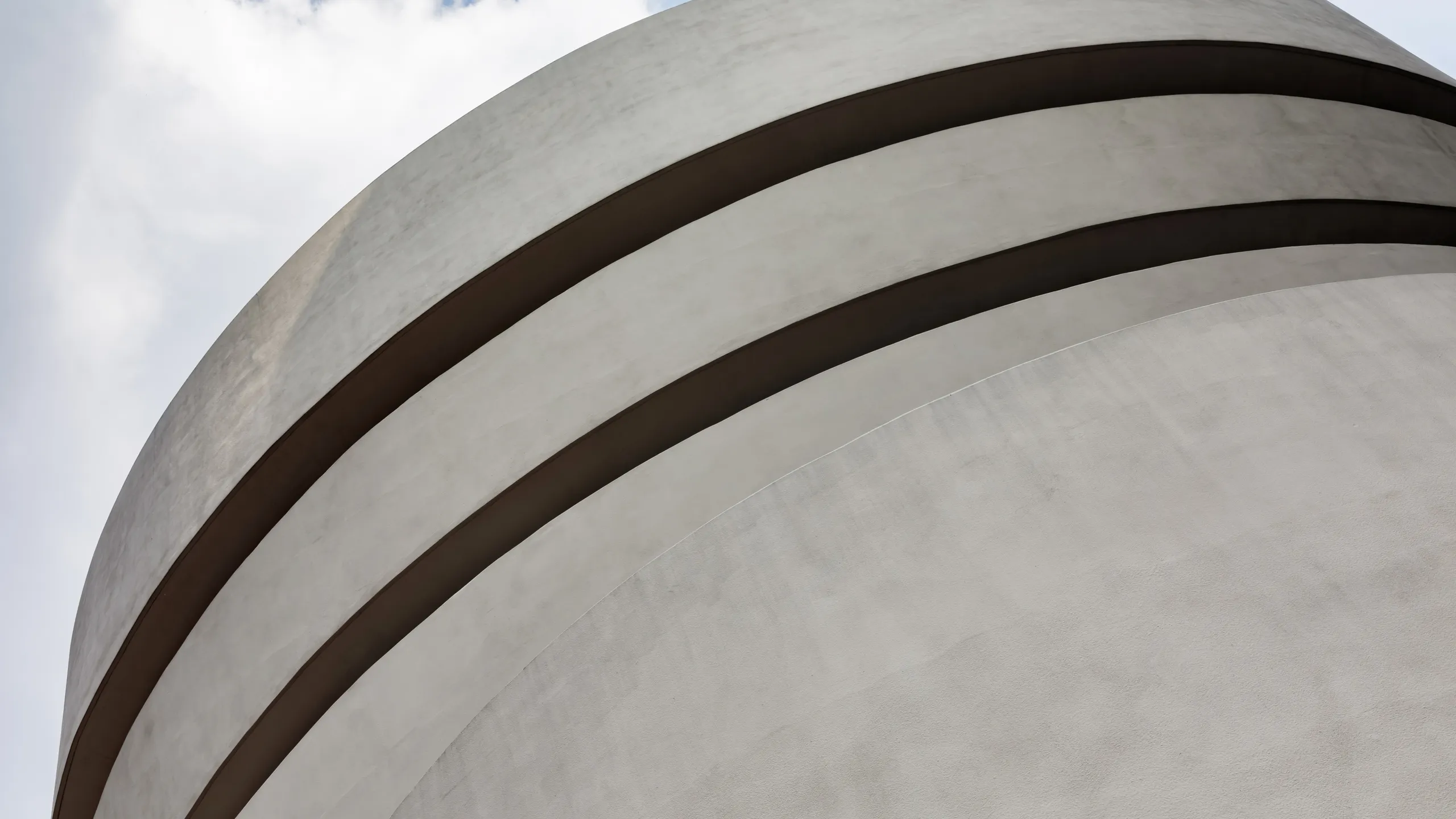
The short answer: New York if you want Frank Lloyd Wright's building and a broad modern collection, Bilbao if you want Frank Gehry's building and the city around it, Venice if you want Peggy Guggenheim's house, garden and the Surrealists and Cubists she collected. Abu Dhabi is not an option yet: it is due to open on December 11, 2026. If you can only go to one, choose by the kind of place you want to stand in, not by the name on the door. We are an independent guide, not affiliated with the museums, and everything below was checked on November 3, 2026.
Which Guggenheim fits which traveler?
The right museum depends less on art taste than on how you travel. Here is the matching we would give a friend, with the reasons.
- First time in New York, short trip: New York. The building is the attraction, it sits on Museum Mile, and it pairs with the Metropolitan Museum six blocks south.
- You like architecture more than paintings: Bilbao first, New York second. Bilbao's exterior is half the visit and you reach it before the ticket desk.
- You like early modernism, Surrealism and Cubism: Venice. Peggy Guggenheim bought those movements as they happened, and the house shows them at domestic scale.
- You like contemporary and large-scale work: Bilbao, where Richard Serra's The Matter of Time is a permanent installation in Gallery 104.
- You are making a city trip anyway: follow the city. Venice and New York are cities you would visit with or without the museum. Bilbao is a trip you can build around it.
- You have a short stopover or a cruise day: Venice is the smallest and easiest to fit into half a day.
- You travel with young children or limited mobility: read our accessibility page before you decide; the venues are very different.
The venues side by side
| Museum | Building | Collection | Realistic visit | Best for |
|---|---|---|---|---|
| New York | Wright's spiral, opened 1959; a quarter-mile ramp at a three-degree incline | Broad modern art; permanent Thannhauser galleries (Degas, Manet, Van Gogh, about thirty Picasso) | About 2 hours; 3 with the Thannhauser galleries | Architecture fans, first-time New York visitors, Museum Mile days |
| Bilbao | Gehry's titanium, limestone and glass, opened October 1997 | Own collection plus rotating shows; Serra's The Matter of Time is permanent | 2 to 3 hours, plus time outside | Architecture, contemporary art, city breaks |
| Venice | Palazzo Venier dei Leoni, a low palazzo on the Grand Canal, plus a sculpture garden | Peggy Guggenheim's own collection and the Schulhof Collection | About 2 hours with the garden | Early modernism, Surrealism, half-day visits |
| Abu Dhabi | Gehry design, not yet open | Not yet announced in full | Not yet known | Do not plan around it before the hours are published |
| Museum | Best season (climate 1991-2020) | Arrival, in one line | Closing day |
|---|---|---|---|
| New York | May to June and September to October (high of 21.9 C in May, 24.6 C in September) | Subway 4, 5, 6 or Q, or bus M1 to M4, to 88th Street on Fifth Avenue | None in the regular week |
| Bilbao | June to September, the driest months (Jul 51.8 mm, Aug 52.7 mm at the airport) | Metro to Moyua, or the Guggenheim tram stop; airport 15 km from the center | Mondays, with listed exceptions |
| Venice | April to May and September to October; avoid November to January for high water | Vaporetto to Accademia (lines 1 and 2) or Salute (line 1) | Tuesdays and December 25 |
| Abu Dhabi | Cooler months (December high of 26.5 C) by the airport normals | Saadiyat Cultural District, Saadiyat Island; no directions published | Not published |
The best-season column is an editorial reading of the climate normals, not a forecast. The full month-by-month work, including charts, is on Best time to visit. The closing-day column is the one most likely to be out of date when you read this: treat it as a prompt to check the current hours on the venue page.
New York: the building that sets the standard
New York is the original. Frank Lloyd Wright took the commission in 1943, the museum opened on October 21, 1959, and Wright had died six months earlier on April 9. He had watched the construction advance but never saw it open. The museum's own visitor guide describes the ramp as a quarter of a mile long, climbing at a three-degree incline, which is a gentler slope than most people expect from the photographs. The outer wall is sprayed concrete (Gunite) about five inches thick.
The building was inscribed on the World Heritage list in 2019, as one of eight Frank Lloyd Wright buildings. The museum calls it Wright's most visited building. What you see inside depends on what is hanging: the permanent Thannhauser galleries are the stable part, with Degas, Manet, Van Gogh and about thirty Picasso, while the rest changes with the temporary shows. That is the one honest caveat about choosing New York for its collection: you are choosing a collection that rotates.
New York also has the gentlest practical profile of the three. It is open every day in the regular week, there is no stated time limit on a visit, and the coat check is free with admission. A pay-what-you-wish window exists on two afternoons a week, which we explain on the tickets page because it changes.

Bilbao: a building you meet before the ticket desk
Bilbao is Frank Gehry's museum, finished in October 1997 on a former port site where the river bends. The skin is titanium, limestone and glass; the museum counts about 33,000 titanium sheets. The building covers 24,000 square meters, of which 9,000 are exhibition space, arranged on three levels around a central atrium.
It is also the venue where the outside counts. Jeff Koons's Puppy, dated 1992 by the museum and installed in Bilbao in 1997, stands in front of the building. Louise Bourgeois's Maman, from 1999, is near the footbridge. Anish Kapoor's Tall Tree & The Eye, from 2009, is in the pond area. The Fire Fountain is by Yves Klein, not Kapoor, and runs in the evening on a seasonal schedule.
Inside, the permanent draw is Richard Serra's The Matter of Time, a steel installation made between 1994 and 2005 that has its own long gallery. Bilbao has its own collection and a program of temporary shows, and the Foundation renewed its agreement with the museum in 2014 for another twenty years, to 2034.
Venice: a house, a garden and a canal
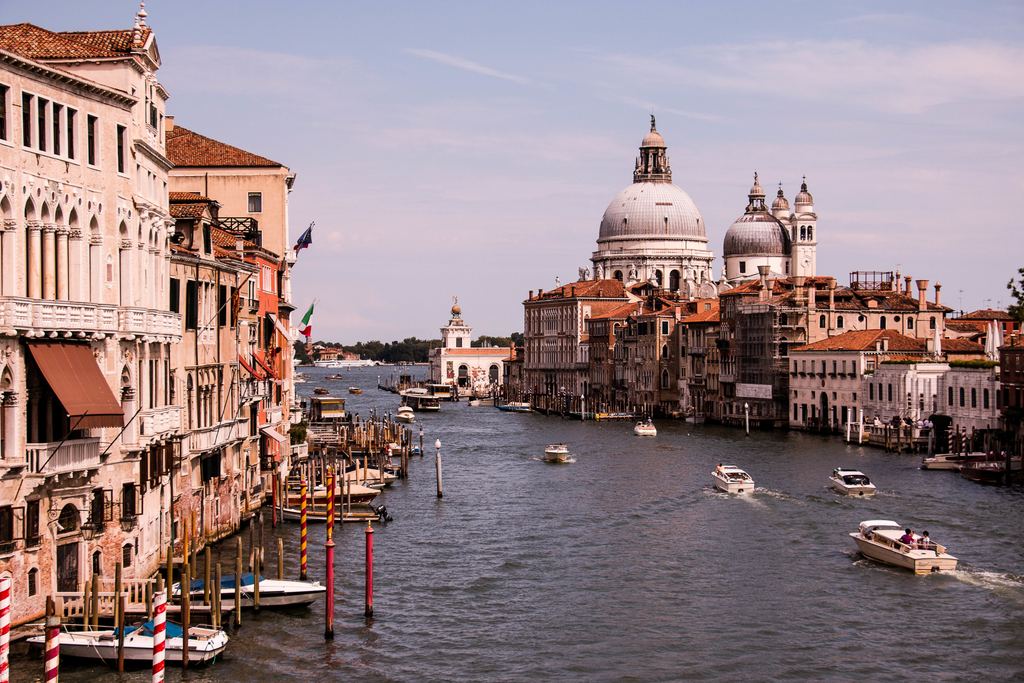
The Peggy Guggenheim Collection is housed in Palazzo Venier dei Leoni, on the Grand Canal between the Accademia bridge and the Salute basilica. The palazzo was commissioned in 1749 and only one of its planned five floors was ever built, which is why it sits so low. Peggy Guggenheim bought it in July 1949 and lived there for thirty years. She began opening the house to the public in 1951, on afternoons, and died in 1979. The museum as the Foundation runs it dates from 1980.
Works in her collection include Brancusi's Maiastra, Magritte's Empire of Light, Max Ernst's The Attirement of the Bride, de Chirico's The Red Tower, Picasso's The Studio, and the Schulhof Collection of twentieth-century work in the barchessa. There is also a sculpture garden. It is a small museum, and that is its attraction: you can see it all without the fatigue that big museums cause.
Venice has the strictest rules of the three: no large items such as bags, backpacks or suitcases, and no food or drink even in the garden. Lockers at the ticket desk are free. Check what to bring before you arrive with luggage.
Abu Dhabi: not yet, and what that means for your plans
Guggenheim Abu Dhabi is due to open on Friday, December 11, 2026, according to the emirate's Department of Culture and Tourism, which announced the date on July 28. It stands in the Saadiyat Cultural District, near the Louvre Abu Dhabi, which opened in 2017. Frank Gehry designed it; he died on December 5, 2025. Abu Dhabi describes it as the largest museum in the Guggenheim network.
Beyond that, the sources disagree or are silent. The tourism department gives about 80,000 square meters of total built area; the number of galleries appears as 28 in some reports and 30 in others. As of November 3, 2026, no opening hours, no inaugural exhibition and no visitor rules had been published, and a full list of works on view had not been released. A price of AED 70 has been reported by two news outlets, but we could not read it on the museum's own site.
So the practical advice is simple. Do not build a trip around Abu Dhabi until the hours and the first exhibition are posted, and do not book a tour that claims to include entry before then. We keep a dated summary of what is known on Guggenheim Abu Dhabi: what we know.

Which one if you can only choose one?
Run these three questions in order and stop at the first yes.
- Is the building the reason? If you would travel to see Wright or Gehry, pick the one nearer your route. They are different experiences: New York is a spiral around a rotunda, Bilbao is a sculpture you walk around.
- Is early modern art the reason? Pick Venice. Surrealism, Cubism and abstraction are what Peggy Guggenheim collected in Paris, London and New York between the wars, and the house is arranged around them.
- Is the city the reason? Pick the city you want to be in. The museum will be a good part of the day in any of the three.
If two of the three questions give different answers, the building usually wins. A collection rotates; a building does not.
How many people visit each one, and why you should not rank on it
| Museum | 2025 visitors | Source | Read with care |
|---|---|---|---|
| Bilbao | 1,305,003 | Museum press release, January 2, 2026 | About 69 percent came from abroad, per the museum |
| New York | 774,057 | The Art Newspaper, April 2026 | Reported as 40 percent below 2019; single secondary source |
| Venice | Over 343,000 | Museum press release, January 8, 2026 | Counted over 313 open days, about 1,100 a day; 61 percent international |
| Abu Dhabi | Not applicable | Not open | No data |
These numbers tell you about demand, not about quality. A different year, a different counting method (tickets, entries, members) or a different source would move them. Bilbao's figure has two versions in circulation: 1,305,003 is the museum's year-end number, and 1,260,894 is a mid-December partial total that some pages still use. New York's 2025 figure comes from one secondary source, and Venice is outside that source's top 150. Do not read the order as a ranking.
How not to compare them
Most "which Guggenheim is best" articles fall into the same traps. These are the five we avoid.
- Do not rank by ticket price. A price comparison ignores what the ticket includes. Bilbao includes an audio guide; New York has a pay-what-you-wish window; Venice works on time-slot booking. Different currencies and different dates make the arithmetic worse. Our tickets page holds dated prices.
- Do not rank by size. Bilbao has 9,000 square meters of exhibition space by the museum's count; Abu Dhabi's 80,000 is total built area, and the tourism department's FAQ gives about 11,600 for its interior galleries. Those are different measures.
- Do not rank by visitor numbers. See the table above.
- Do not expect the same art. The four museums are linked by the Guggenheim name, not by a shared wall. Venice shows Peggy Guggenheim's own collection; Bilbao has a collection of its own plus visiting shows; New York rotates its holdings. Exhibitions named in older guides are usually gone.
- Do not trust last year's guide. On November 3, 2026 several popular pages still listed a Saturday-evening free window for New York. The museum's own page now places its pay-what-you-wish window on two different afternoons. Check the date on anything that mentions a time of day.
The Guggenheim name covers four buildings with four collections and four sets of rules. Treat them as four trips, not one brand.
Pairing a Guggenheim with something else
The choice often comes down to what sits next to the museum. In New York, the Metropolitan Museum of Art is at 82nd Street and the Guggenheim at 88th, about six blocks (roughly eight minutes on foot by our own estimate). The Neue Galerie, Cooper Hewitt and the Jewish Museum are all within a few more. In Bilbao, San Sebastián is a coastal day trip, about an hour and a quarter by road or bus, and the Basque coast adds more. In Venice, the museum is in Dorsoduro. Its own site lists a reduced fare when you show a ticket from neighboring museums, a point we explain on the itineraries page.
For tour formats at each venue, see our guides to New York, Bilbao and Venice.
Questions about choosing a Guggenheim
Which Guggenheim museum is the best?
None is best in general. New York has the famous Wright building, Bilbao has the Gehry building and its city, and Venice has the most intimate visit. Choose by the kind of place you want to be in.
Is the Guggenheim in New York or Bilbao better?
For architecture, they are different rather than ranked: a spiral rotunda versus a titanium sculpture. For a trip, the city decides. Bilbao suits a Basque Country trip; New York suits a Manhattan one.
Is the Peggy Guggenheim Collection worth visiting?
Yes if you like early modernism and Surrealism and want a small museum you can finish in about two hours, with the garden. It is a poor fit if you want a large, changing contemporary program.
How long does each Guggenheim take?
None of the museums publishes a recommended duration. Our planning allowance is about two hours for New York, two to three for Bilbao, and about two for Venice, plus time outside in Bilbao.
Can I see more than one Guggenheim in a single trip?
Only on a multi-city trip: New York, Bilbao and Venice are in three countries, and each museum deserves most of a day.
Is Guggenheim Abu Dhabi open yet?
No. As of November 3, 2026 it is scheduled to open on December 11, 2026. Hours and exhibitions had not been published.
Why are the visitor figures so different?
They come from different sources and counting methods, and the museums are different sizes. See the visitor table above for the 2025 numbers and caveats.
Pick the museum, then pick the month
Once you know which Guggenheim, the next decision is when. Our month-by-month page has the climate figures and the Venice high-water season.
Back to the trip plan
The full eight-step plan, from the choice of museum to the daily route.
Data verified on . Checked against the museums' own sites on 3 November 2026. How we work is on our editorial policy page. Editorial Policy